
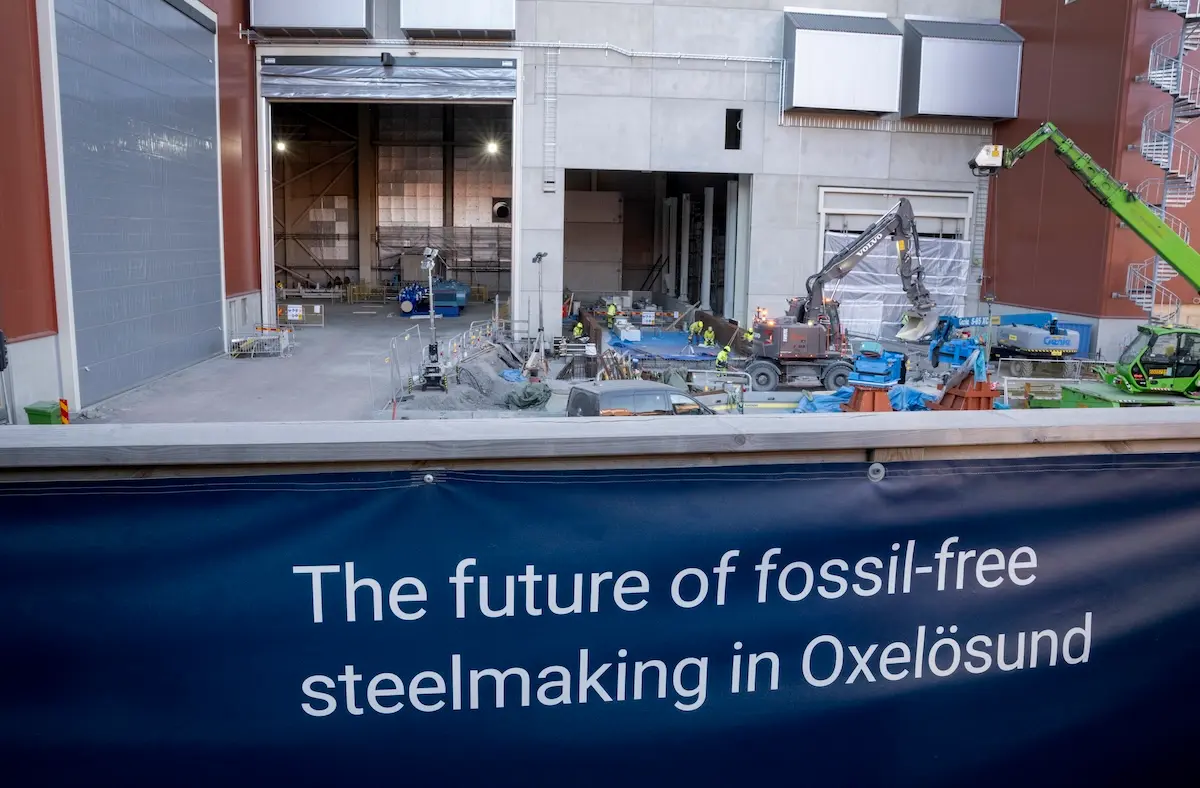
After the Migration Agency made its decision, the 19 workers were released from the detention centres where they were being held and are now free to go back and finish the job they were carrying out at SSAB's new steel plant in Oxelösund.
In Sweden, the police can decide to deport someone they believe is living in the country illegally and impose a re-entry ban. The person can appeal to the Swedish Migration Agency, which reviews the decision. If the agency rejects the appeal, the case can proceed to the Migration Court. If it overturns the police’s decision, the police must respect that ruling.
The police seized the 19 workers in a raid at the site on October 7th, carried out in cooperation with seven government agencies – the Swedish Work Environment Agency, the Swedish Public Employment Service, the Swedish Economic Crime Authority, the Swedish Social Insurance Agency, the Swedish Gender Equality Agency and the Swedish Tax Agency.
"A total of 20 foreign nationals were found to be without permission to reside and work in Sweden. They have now been taken into custody and will be deported from Sweden with a re-entry ban," the police said in a press release. (One of the workers was back in The Netherlands at the time of the raid, so was not in fact seized.)
But on October 16th, the Migration Agency ruled that the engineers had the right to work in Sweden, and the removal and entry bans were then set aside.
READ ALSO: Foreign SSAB workers released as Dutch lawyer slams Swedish site raid
Isman said the police judged that the engineers were in Sweden illegally because they were employed by a Dutch company that had leased the staff out to an Italian company which had then posted them to Sweden.
"The police made the assessment that the Dutch employer is fictitious more or less. They are here working in the uniforms of the Italian company but they have no employment relationship with the Italian company and the police thought that this was just to circumvent the rules and how contracts should look in such a posting," she said.
"It is required that the company sending staff to Sweden reports it to the Work Environment and in this case it was then the Italian company that did so and the police assessed that it should have been the Dutch company."
When the Migration Agency looked at the case, however, they disagreed.
"We came to a different assessment. We considered that you are actually allowed to do this, as there is an exception in the provision where it says that if the employer, that is to say the one in The Netherlands, lends the staff to another enterprise, in Italy in this case, then that enterprise can send staff to Sweden.
"Then all other conditions must still be fulfilled: they must have employment in the Netherlands; they must have housing and a residence permit and insurance conditions in The Netherlands."
The police also, she said, thought it was wrong that the company posting the workers was now applying for them to have Swedish residency permits as this would mean their residency in The Netherlands would lapse, but she said that the Migration Agency had again come to a different conclusion, that the "tripartite relationship Netherlands-Italy-Sweden is okay".
She stressed that the rules on EU posted workers are "very complicated" and that the police had done a thorough and professional job.
"The police have done this with good intentions to ensure that people aren't exploited in the workplace," she said. "There are indeed big risks with this [EU posting directive] that third-country nationals get exploited and that we don't have any possibility to check them because they don't need to have a work permit and this is a rule that I believe is used to circumvent Swedish rules."
In this case, she said, the arrangement had been legal.
"In this case, we made the assessment that everything was correct. But we have had earlier cases where we have agreed with the police that this looks suspect and the employment relationship underlying this doesn't feel okay and then we have rejected appeals. So these are complicated rules where many authorities are involved."
After the release, the police told The Local in a statement that they did not agree with the Migration Agency's decision.
"For our part, we do not share that assessment. We believe that there are circumstances surrounding the posting and the reports to the Swedish Work Environment Authority that indicate that the conditions for posting do not apply," they said. "We are continuing to work on the case and conducting further checks to review the arrangement."
The police also called for Sweden's government to tighten the law on EU postings to prevent abuse.
While Isman said it may be possible to tighten the rules somewhat, she said Sweden remained bound by EU rules and the rulings of the European Court of Justice.
"Certain rules and certain case law we have internally, so to a certain extent we can regulate it nationally, but then we must also follow EU case law and EU law."
Comments